
 Facebook
 X
X
 Pinterest
 Copy Link
The List Most People Miss
School Capacity and Real Estate
Every spring, Cy-Fair ISD opens a two-month transfer window. Families can apply to send their children to a school outside their assigned zone.
Most people focus on which schools are accepting transfers.
The more interesting list is usually the schools that aren’t.
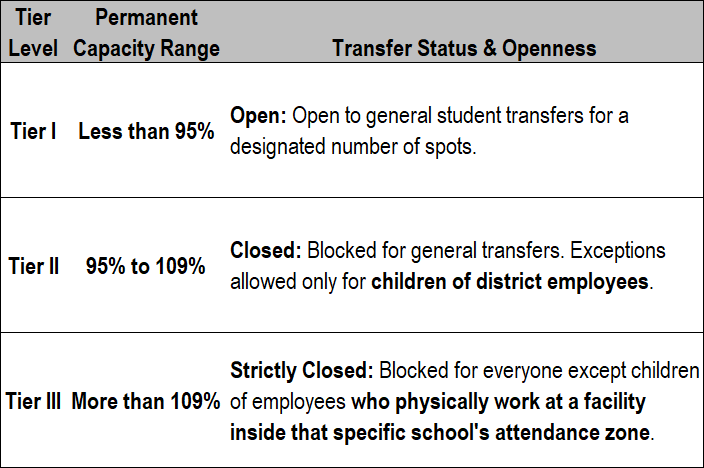
For the 2026-27 school year, Bridgeland High School and Cypress Woods High School were designated as Tier III campuses. In Cy-Fair’s system, Tier III campuses are projected above 109% of capacity and are generally closed to new transfers.
That matters because it isn’t opinion.
It isn’t sentiment.
It isn’t a headline.
It’s capacity data.
In CFISD’s framework, Tier III is a measurement. The district either has seats available or it doesn’t.
School districts don’t restrict transfers to make a point. They restrict transfers because space is becoming limited.
A comparable sale tells us what a buyer paid for a home at some point in the past.
A transfer restriction tells us something about demand happening right now.
What the Numbers Are Telling Us
The transfer designations don’t exist on their own.
Around Bridgeland, the broader pattern points in the same direction.
Harmony Science Academy is moving forward with a new middle and high school campus in Creekland Village. The project is expected to cost about $34 million, cover more than 81,000 square feet, and serve roughly 850 students.
At the same time, Bridgeland High School is completing a $6.1 million renovation funded through a previous bond program.
Additional school investments and future capacity planning are already underway across the district.
Those projects don’t create demand.
They respond to it.
The more useful question is not whether a campus is full.
The more useful question is why so many groups are adding capacity at the same time.
The Signal Doesn’t Stop at Schools
Schools aren’t the only source of information.
Retail investors, builders, developers, and institutions make decisions based on where they believe demand is heading.
Bridgeland Central continues to add commercial activity. The 925-acre district includes Village Green, anchored by H-E-B, along with new office and retail development.
In March 2026, a nearly 40,000-square-foot retail center at the entrance to Bridgeland sold fully leased.
Builders continue to introduce new homes and new price points throughout the area.
Viewed one at a time, these look like separate projects.
Viewed together, they tell a larger story.
When several groups with significant capital are expanding in the same corridor, they are often responding to similar demand trends.
Why Homeowners Should Pay Attention
Check out these listings in CyFair…4bed with a pool on 1/4 acre or more built since 2000
None of this changes what someone paid for a home three years ago.
It may, however, influence how future buyers view the area.
One of the easiest mistakes homeowners make is assuming today’s conditions will still exist when it’s time to sell.
Communities don’t work that way.
They evolve.
- School boundaries change.
- Infrastructure expands.
- Commercial development follows rooftops.
- New schools open.
- Older campuses become less crowded.
As districts add schools and shift students around, attendance boundaries can change.
A buyer evaluating a property five years from now may be looking at a different version of the community than the one that exists today.
That’s one reason I pay attention to information that never appears on a listing sheet.
A property’s future resale story is shaped by more than bedrooms, bathrooms, and square footage.
It is also shaped by schools, infrastructure, amenities, and public investment.
What I’d Watch
If this were my decision, I would spend less time looking at the latest comparable sale and more time watching the indicators that tend to move first.
- School capacity
- Bond programs
- Infrastructure investment
- Commercial development
- Construction activity
Those are often the places where change shows up first.
Most people focus on the number everybody already knows: what the house down the street sold for.
Sometimes that’s enough.
In a fast-moving corridor, the more useful information is often hiding somewhere else.
Not on a listing sheet.
Not on a real estate website.
But in the decisions communities are making today that will shape what buyers see tomorrow.
