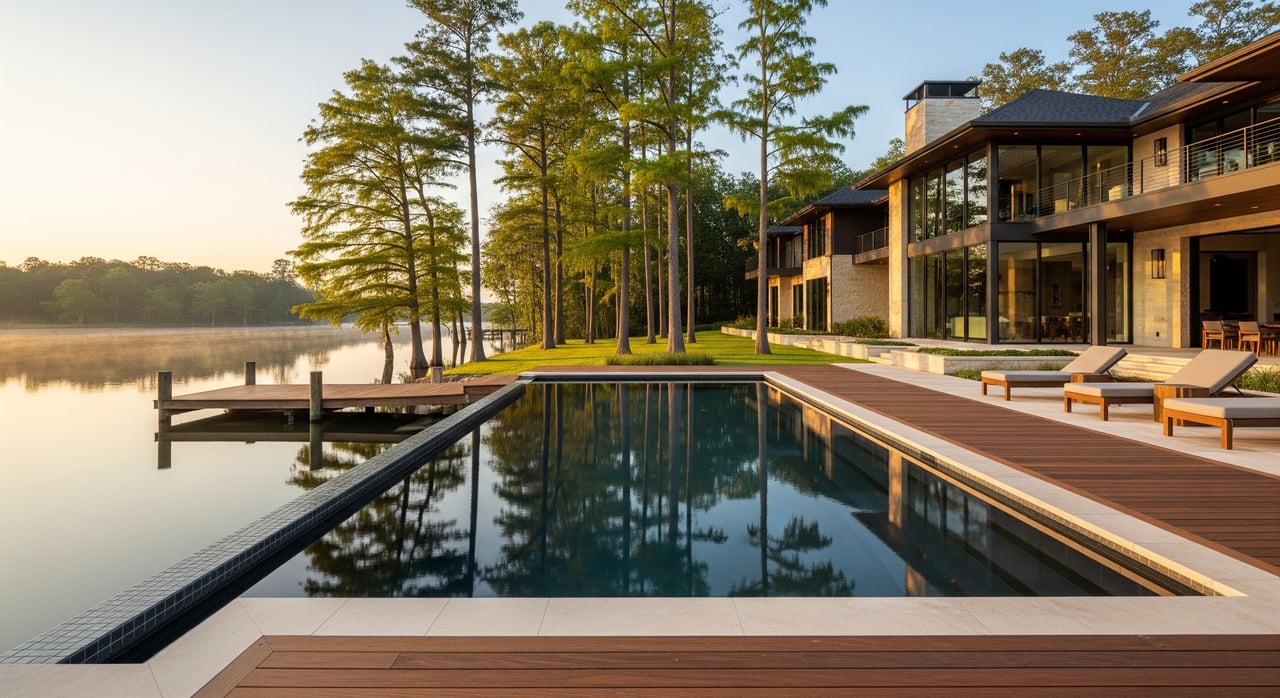
What It’s Really Like Living in The Woodlands TX
Long-Range Value Dave Jensen February 5, 2026
Long-Range Value Dave Jensen February 5, 2026
Many people look at The Woodlands because it checks obvious boxes — trees, trails, shopping, strong schools, and a recognizable name.
But buyers rarely struggle because a place lacks features.
They struggle because the evidence doesn’t clearly confirm their lifestyle.
The Woodlands is a good example of a community where the decision becomes clear only after you understand how daily life organizes itself.
This isn’t really a suburb.
It’s a system.
And people either relax into that structure quickly — or keep second-guessing.
The Woodlands is a large master-planned community north of Houston organized into villages around commercial centers and pathways.
Instead of growing outward from roads like most suburbs, it was designed inward — daily activity funnels toward specific nodes.
That design changes behavior.
You don’t simply live near things.
You move through a predictable pattern of places.
Some buyers experience this as calm.
Others experience it as confinement.
Understanding that difference prevents months of unnecessary comparison.
Most communities are evaluated by features.
The Woodlands is experienced by rhythm.
Typical patterns:
• routines repeat week to week
• errands happen in the same few centers
• recreation is integrated into normal movement
• social life clusters geographically
You will likely visit the same grocery store, same restaurants, same paths, same activity areas regularly — not because options are limited, but because the design naturally concentrates behavior.
People who enjoy familiarity tend to settle quickly here.
People who want constant variation often keep searching even after moving in.
Buyers often think the trails and trees are amenities.
They are actually transportation.
Residents bike to school, walk to events, and use paths as part of normal routines.
This reduces decision friction — fewer daily choices about where to go or how to spend time.
If you want lifestyle spontaneity, it can feel repetitive.
If you want mental simplicity, it feels relieving.
This is why some households become deeply attached to The Woodlands while others quietly move after a few years despite liking the houses.
Most buyers compare villages by price, age, or school zoning.
But the meaningful difference is how much the environment changes day to day.
Near Town Center:
more variation
more activity
less predictability
Outer villages:
quieter patterns
stronger routines
fewer daily decisions
Neither is better.
They just suit different decision personalities.
When buyers struggle choosing between villages, they’re usually deciding how much daily variety they want — not which house.
Yes, there are layered costs: taxes, HOA, township fees, utility districts.
But the real effect isn’t the amount — it’s predictability.
Master-planned communities trade financial simplicity for lifestyle certainty.
Some buyers feel comfort knowing exactly what the environment will remain like.
Others feel constrained by paying to preserve uniformity.
Recognizing which reaction you have prevents long-term dissatisfaction more than calculating tax rates does.
Commutes from The Woodlands vary widely, but the important part is this:
Residents tend to structure their day around avoiding peak movement.
The community works best for people who:
have flexible schedules
work nearby
or prefer stable daily timing
If your life requires constant cross-city movement, the structure that helps many residents feel organized can instead feel restrictive.
Buyers often delay decisions researching data categories:
ratings, maps, statistics.
Those matter, but in The Woodlands they rarely determine satisfaction.
What determines satisfaction is whether you enjoy living inside a designed environment rather than an organic one.
People who need continuous discovery sometimes keep searching for “the right house” when they are really reacting to the community pattern.
Morning: similar start each weekday — paths, school routes, predictable traffic timing
Midday: local errands clustered nearby
Evening: repeated activity zones (parks, Waterway, restaurants)
Weekend: organized events instead of improvised outings
For many households this removes background stress.
For others it removes energy.
The Woodlands works well if you want:
structured daily rhythm
visual consistency
low decision fatigue
familiar environments
It works less well if you want:
constant novelty
spontaneous routing
irregular schedules
evolving surroundings
Most buyers don’t struggle choosing a house here.
They struggle recognizing which lifestyle they prefer.
Once that becomes clear, the decision usually follows quickly.
Stay up to date on the latest real estate trends.
Why homeowners in the 4–7 year window often discover misalignment too late
When Comfort Quietly Delays Your Next Move
Sellers
When the renovation is finished, the exit gets harder

Exit Velocity and the Hidden Cost of Illiquid Real Estate

Why the home that solved today’s instability can quietly shape tomorrow’s constraints
Why most real estate choices feel right at purchase — and restrictive years later

Where Houston’s most discerning households turn to understand the signals that shape their next move.
Leveraging experience and data to produce a solution that's a fit for you, your current and long-term goals. And it starts with our first conversation. Call today!

1335 Lake Woodlands Dr C The Woodlands TX 77380