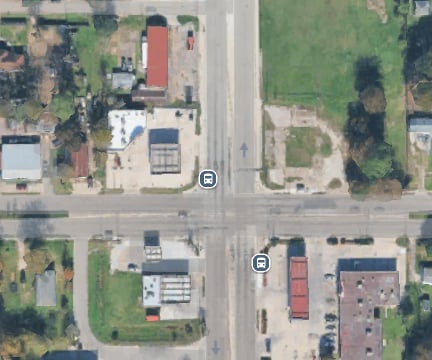
Why Hard Corner Lots Matter in Northeast Houston
Dave Jensen April 12, 2026
Dave Jensen April 12, 2026
Spend enough time around commercial developers or seasoned land investors and you’ll hear someone describe a parcel as a hard corner. They say it with the same precision a jeweler uses when calling a stone “eye‑clean.” The term carries weight for those who understand it — and almost none for those who don’t.
This article is for everyone else.
A hard‑corner lot is one of the most strategically valuable parcel types in land development. Its geometry alone can influence visibility, access, circulation, entitlement feasibility, and long‑term appreciation. In Northeast Houston — where redevelopment pressure, corridor reinvestment, and infill demand are accelerating — the value of a hard corner becomes even more pronounced.
Defining the Hard Corner
A hard‑corner lot sits directly at the intersection of two public roads, with full, unobstructed frontage on both. The parcel touches both streets, creating two visibility planes and two access opportunities.
A soft corner sits near an intersection but lacks frontage on one of the roads. A mid‑block lot has frontage on only one. A flag lot hides behind another parcel with minimal visibility.
A hard corner is the geometric opposite of a flag lot — and the most flexible of the three.
Hard Corner vs. Mid‑Block Lot
A mid‑block lot works fine for residential use. For commercial use, it is inherently limited:
A hard corner, by contrast, offers:
For any use that depends on traffic, visibility, or ease of access, the corner almost always wins.
Why Developers Pay Premiums for Hard Corners
The premium is not emotional. It is structural.
Visibility & Signage
Retail tenants — especially drive‑through restaurants, fuel stations, banks, and convenience stores — make decisions based on visibility. A hard corner allows signage to face two traffic streams, doubling exposure without doubling cost.
Access & Circulation
Traffic engineers regulate driveway cuts. A mid‑block parcel on a busy arterial may get one right‑in/right‑out. A hard corner may qualify for:
This can be the difference between a site that works and a site that doesn’t.
Entitlement Feasibility
Houston’s land‑use framework relies on deed restrictions, ordinances, and permitting rather than traditional zoning. Corner parcels often sit at natural transition points between uses — retail on one side, residential on the other.
Approval bodies tend to favor commercial activity at intersections because it aligns with existing patterns. A hard corner is often the most “logical” place for new commercial use.
Higher Appraised Values
Appraisers weigh frontage, visibility, and access heavily. Hard corners consistently appraise higher than interior parcels of the same size because they support higher‑yield uses.
Higher appraisals also improve loan‑to‑value ratios for developers.
The Northeast Houston Context
Hard corners are valuable anywhere. But in Northeast Houston, their value is amplified by a specific set of forces:
Unlike the northwest suburbs — where value is driven by new master‑planned communities — Northeast Houston’s value is driven by infill, repositioning, and corridor revitalization. That means:
A hard corner in this environment is not speculative. It is a scarce geometry in a submarket where visibility and access directly determine use potential.
How Corner Parcels Perform Over Time
Across Texas metros, corner parcels consistently outperform interior parcels in long‑term appreciation. The reasons are structural:
Mid‑block parcels can lose relative value as surrounding structures grow taller or closer. Hard corners do not suffer from that compression.
A Live Example: Listing #8 — Northeast Houston
Listing #8 in my current portfolio is a vacant hard‑corner lot in Northeast Houston, positioned with full frontage on both streets.
It sits within an active reinvestment corridor where:
I mention it here not as a pitch, but as a real‑time illustration of the principles above. The geometry, the visibility, and the corridor context are exactly why hard corners matter — and why investors consistently pursue them.
If you want a breakdown of the surrounding development activity, comparable corner‑parcel performance, or the use cases this site supports, reach out directly.
Key Takeaways
Understanding the geometry is the first step. Recognizing the opportunity is the second.
Stay up to date on the latest real estate trends.
How a client's vision for education, childcare, and community became a real estate deal — and what it teaches about the order every goal requires.

It's showing up now.

Leveraging experience and data to produce a solution that's a fit for you, your current and long-term goals. And it starts with our first conversation. Call today!

1335 Lake Woodlands Dr C The Woodlands TX 77380